Don't let that reversing valve outsmart you
Once you finally figure out which component is causing the problem, then you have to replace them, which can be even worse. Many split systems are tall and difficult to lift a compressor out of. Reversing valves can be difficult to remove because they have four solder joints to deal with at the same time and, to make matters worse, they are very heat sensitive.
Compressor valves vs. reversing valves
We’ll start off with troubleshooting reversing valves and then move on to tips that aid compressor and reversing valve removal and replacement.Defective reversing valves can sometimes be hard to detect, particularly in mild weather.
Weak compressor valves and bleeding reversing valves are usually characterized by higher-than-normal back pressure and lower-than-normal high-side pressure, as well as low system capacity. Because of this, the two malfunctions can be confused. I place these two malfunctions under the heading of “hot gas bypass.”
Another malfunction that can also give similar symptoms is a liquid bypass. This is a bypass from the liquid system to the low side and will also cause high back and low head pressures. A liquid bypass could be caused by a stuck- open expansion valve, leaky check valve, or an oversized or poorly seated fixed orifice.
Recently a participant at one of my compressor diagnostic classes had condemned a compressor the day before the class. The day after the class he rechecked his work and discovered the system had a leaky check valve. If you find a system that has high back pressure and low high-side pressure, don’t assume that the compressor is at fault.
The first step to diagnosing high-back and low-head symptoms is to determine if the evaporator coil is flooded with liquid refrigerant. If the evaporator is flooded, the problem is very likely a liquid bypass.
If a system with a liquid bypass has an expansion valve metering device, the superheat will be much lower than 12°F. It could be as low as 0° or sometimes appear to have negative superheat. There is no such thing as negative superheat, but if the system has a fixed orifice or cap tube, the superheat will be much lower than the factory-recommended reading.
Looking for quick answers on air conditioning, heating and refrigeration topics? Try Ask ACHR NEWS, our new smart AI search tool. Ask ACHR NEWS
Remember, on fixed-orifice and cap-tube systems you must use a superheat chart to determine the correct superheat for the load conditions at the time of your diagnosis. In many cases, if you find that the superheat is too low in conjunction with high back and low head, you may have a liquid bypass, not a compressor or reversing valve failure.
There are exceptions to this, but in most cases this information will serve you well. Remember to check for a flooded evaporator coil before trying the following diagnostic technique.
|
|
| Figure 1. Troubleshooting points: A) suction line, B) compressor dome, C) suction line. |

Troubleshooting the reversing valve
Once you determine that there is no liquid bypass, the next step is to check the compressor and reversing valve.1. Disable the condenser motor; while the system is operating, allow the head pressure to rise until it will not go any higher or the pressure reaches 475 lb, whichever occurs first. Remember, if you are working in heating mode, the condenser motor is the indoor motor.
2. Turn the system off. This quiets the machine and disables the fans so you can listen and feel for the problem. Also, the increased pressures developed during this test intensify the symptoms, making them easier to detect. If the reversing valve is energized during this test, you will have to “hot wire” it prior to running this test so that it will not de-energize when you turn the machine off.
3. At this point you might be able to hear a hissing noise from the source of the hot gas bypass. If you are still not sure which of the two components is leaking, place one hand on the compressor dome or the suction line (see Figure 1, points A and B) as it enters the compressor, and the other hand on the suction line (Figure 1, point C) as it exits the reversing valve. One end of the line or the other will probably get much hotter, much faster.
If the compressor end gets very hot very fast, the compressor is at fault. If the reversing valve gets very hot very fast, the problem is the reversing valve.
If you still cannot determine which is the problem, it most likely is the compressor, because the location where you touch the compressor is removed from the source of the hot gas. On the other hand, the location where you touch the reversing valve is very near where the hot gas will be bleeding through. So if the compressor is bleeding, you may not be able to tell easily, but if the reversing valve is bleeding, you will have no doubt.
Another thing to remember is that a compressor can have weak valves yet not have hot gas bypass, so if the reversing valve is OK, the compressor has to be the source of the problem.
There is a nasty rumor going around that a reversing valve should only have X-amount of temperature rise across it while the machine is operating. You may be told many different numbers, anywhere between 3° and 8°. Don’t take this information too seriously.
On systems that have fixed metering devices, like orifice or cap-tube machines, the amount of liquid refrigerant that returns down the suction line back to reversing valve changes with the load condition on the machine. These small globules of liquid refrigerant suspended in the suction gases can absorb heat from the wayward hot gas bleeding across the valve diminishing the amount of sensible heat rise across the valve.
What does this mean to you? The answer is in tip number 4 in the sidebar article above.
|
|
| Figure 2. Points for removing the reversing valve. |
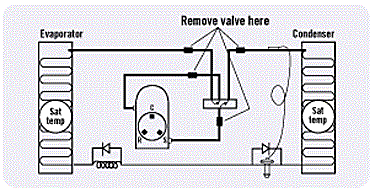
Tips for replacing reversing valves
Some reversing valves are installed so tightly, it is difficult to remove the pipes one by one. Trying to put enough heat into all three suction line fittings simultaneously to remove the valve is tricky.Did you ever wonder how the factory gets them into the machine without burning them? If you step back from the unit, you’ll notice that a short distance down each pipe as it moves away from the valve, there is a joint (Figure 2). The factory brazes these suction pipes onto the valve before they install it into the machine. That way, they can braze each line into the valve separately, and so have much more control over the process.
To remove the valve, locate the closest fittings near it; remove the valve and its three-pipe manifold. (I usually remove the fourth small hot gas line from the valve while it is still in the machine.) Mark the pipes with a scratch as a reference for reinstalling them in the new valve. Using the scratch will ensure that the marks are still there after applying heat to them.
Don’t forget to use a wet rag or thermo paste to prevent heat damage to the new valve. Once the old valve is out of the machine, remove the pipes from the old valve and braze them into the new one, orienting the valve for easiest brazing.
Now replace the entire manifold into the machine and braze the three manifold fittings back together.
This reminds of a valuable brazing technique. This is a great technique for brazing any temperature-sensitive device, like valves and driers. When brazing the pipes into the new valve, apply the flame only to the pipe until it will take solder. Once it will take solder, move the flame to the valve fitting and in just moments, the joint will take solder. It is a common mistake for techs to apply their torch to the fitting too soon. This overheats the valve.
|
|
| Figure 3. Compressor removal technique. |

Compressor replacement
The most frustrating type of compressor replacement involves the big compressor in the tall outdoor section of a split system. Bending over and into a partially dismantled condenser to lift a heavy compressor up and out of the machine is not only difficult, but it will make you wish you were married to a chiropractor.Anyway, there is an easier way to get these compressors out of the machine. It may not be worth the trouble for small machines, but for big ones it’s sweet. Take note of how the condensers are piped inside the cabinet. The suction and liquid lines almost always exit the cabinet at the same location. This allows you to disconnect the pipes and wiring from the compressor, take the screws out where the side panels attach to the base pan, and tip the cabinet, coil, and piping up to leave the compressor and base pan sitting on the ground.
There must be a little give in the suction and liquid line pipes between the condenser and where they enter the structure, because they will twist a little (see Figure 3). If there is not enough give in the pipes, you can always cut and reconnect them later.
Prop the cabinet up so that you can get the compressor out from ground level. After detaching the feet holddowns, slide a pry bar under the compressor and lever it off the base pan and out where you can get hold of it.
Start using this technique now so you don’t end up like us old farts, limping and groaning our way from one call to another.
Looking for a reprint of this article?
From high-res PDFs to custom plaques, order your copy today!


